
Description
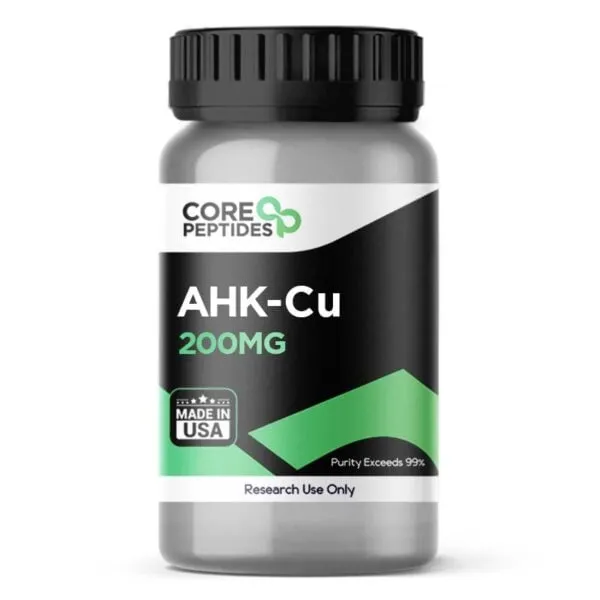
AHK-Cu
AHK-Cu is a peptide composed of amino acids alanine, histidine, and lysine, with a copper ion coordinated by various parts of these three amino acids.(1) This peptide appears to be naturally present in the bloodstream and has been suggested as a potential element in regulating the growth, development, and apoptosis of vascular endothelial cells.
AHK-Cu, also known as copper AHK, has been researched for its potential in hair growth and supporting skin tissue integrity. This peptide has been suggested to exhibit its potential primarily on fibroblasts, responsible for maintaining and growing the extracellular matrix (ECM) components surrounding the cells. Fibroblasts also appear to secrete various biological substances, including the Vascular Endothelial Growth Factor (VEGF), which is suggested to promote the formation of new blood vessels.
The copper ion in AHK-Cu is suggested to be involved in enzyme activity related to collagen and elastin synthesis. These two proteins are critical components of the extracellular matrix and play a role in maintaining the skin tissues’ structural integrity. Copper ions are also suggested to exhibit antioxidant properties.
Chemical Makeup(2)
Molecular Formula: C15H25CuN6O4
Molecular Weight: 416.9 g/mol
Other known titles: ALA-HIS-LYS-CU, L-Alanyl-κN-L-histidyl-κN,κN3-L-lysinato(2-)]copper Monohydrochloride
Research and Clinical Studies
AHK-Cu Peptide and Antioxidative Potential
AHK-Cu is posited to have potent antioxidant qualities, primarily due to its distinct amino acid structure. Based on the antioxidative properties of this peptide, studies have suggested its potential in amplifying hair follicle size, which may increase growth. This peptide has been the focus of numerous in-vitro investigations, particularly concerning its role in hair growth. These studies uniformly suggest AHK-Cu’s potential to foster hair follicle development. In addition to hair growth, AHK-Cu’s scope of application may extend to cell aging, wound healing, and other areas, according to researchers. They posit its potential role in boosting dermal cell multiplication and survival, both of which are essential in collagen production. Collagen is a vital element for maintaining skin cell turnover and function, and the increased cell activity provided by AHK-Cu may facilitate this process.(3)
AHK-Cu Peptide and Hair Follicle Development
Researchers posit that the tripeptide AHK-Cu may potentially stimulate the proliferation of dermal fibroblasts, a type of cell that produces substances like vascular endothelial growth factor (VEGF), which are considered to be crucial for the growth of blood vessels. AHK-Cu may also reduce the secretion of transforming growth factor-beta1 by dermal fibroblasts.
In a recent study,(4) the potential of AHK-Cu on hair growth was investigated. It was suggested that the peptide may promote the elongation of hair follicles and the proliferation of dermal papilla cells (DPCs), which are specialized fibroblasts with a potential to increase the growth and development of hair follicles. Moreover, the authors suggested that the presence of AHK-Cu may have reduced the number of apoptotic dermal papilla cells. Further analysis suggested that the peptide may have increased the ratio of Bcl-2/Bax, and potentially decreased cleaved caspase-3 and PARP levels, two markers of cell death. The Bcl-2/Bax ratio is suggested to play a potential role in the regulation of apoptosis. Bcl-2 is posited as an anti-apoptotic protein that apparently inhibits cell death, while Bax is suggested to be a pro-apoptotic protein that promotes cell death. Thus, a higher Bcl-2/Bax ratio is posted as a predominance of Bcl-2, which may inhibit apoptosis and apparently promotes cell survival. Ultimately, the researchers suggested that AHK-Cu “stimulated the elongation of […] hair follicles […] and the proliferation of DPCs in vitro.” Based on these observations, the researchers commented, “The present study proposed that AHK-Cu promotes the growth of […] hair follicles, and this stimulatory effect may occur due to stimulation of the proliferation and the preclusion of the apoptosis of DPCs.”(4). Other researchers delving into this trial also noticed that the peptide may have interacted with VEGF and Transforming Growth Factor Beta 1 (TGF-β1). TGF-β1 is researched for its role in cell proliferation, differentiation, and apoptosis. It is posited to be involved in several cellular processes, including the regulation of immune responses and wound healing. By potentially downregulating TGF-β1, AHK-Cu may alter these cellular processes, possibly affecting cell growth and the immune response at a cellular level. On the other hand VEGF is researched for its role in angiogenesis, the formation of new blood vessels from pre-existing vessels. The upregulation of VEGF by AHK-Cu might imply an enhanced potential for angiogenesis, which could influence nutrient and oxygen supply at the cellular level.(5) VEGF specifically is posited to foster the development of blood vessels surrounding hair follicles. This action potentially aids in delivering nutrients and oxygen to the hair follicles, thereby supporting hair growth.


Reviews
There are no reviews yet.